

There is no universal answer to how often you should perform balance calibration. The right schedule depends on your industry, accuracy requirements, usage intensity and regulatory obligations. Calibrate too often and you waste time and money. Calibrate too rarely and you risk inaccurate results, failed audits and product quality issues.
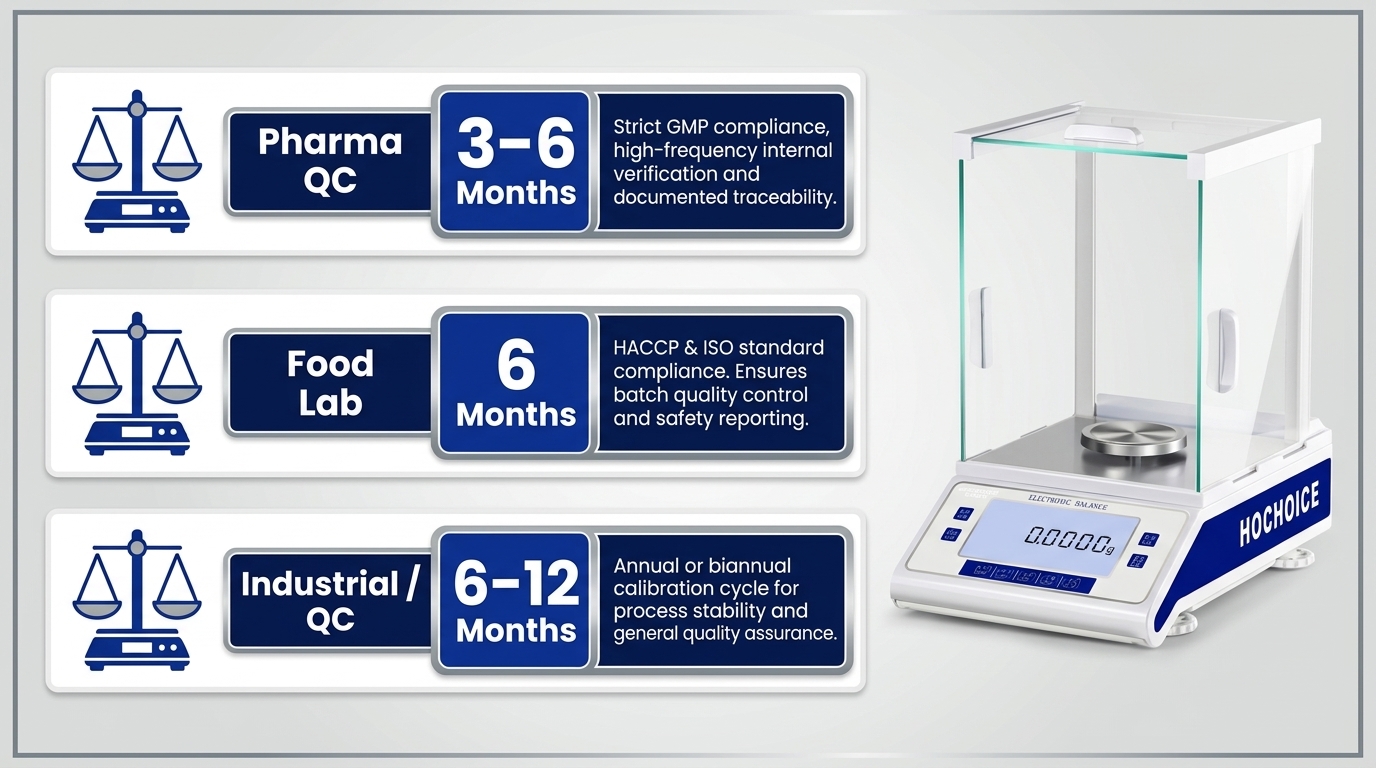
Accuracy class of the balanceHigher precision instruments drift faster relative to their tolerance. 0.1mg analytical balances need more frequent calibration than 0.1g industrial bench scales.
Usage intensityBalances used multiple times per day, across shifts, or for heavy workloads drift faster than occasionally used instruments.
Environment stabilityFacilities with temperature fluctuations, vibration or dust will experience faster calibration drift than controlled lab environments.
Regulatory requirementsPharmaceutical, medical device and food safety industries have mandatory calibration frequency requirements for QC equipment.
Risk levelWeighing results that impact product release, patient safety or regulatory compliance require more frequent verification.
| Balance Type | Industry / Application | Recommended Calibration Frequency |
|---|---|---|
| 0.1mg Analytical Balance | Pharmaceutical QC / medical device | Every 3–6 months + daily zero check |
| 0.1mg Analytical Balance | Food testing / general R&D | Every 6 months + weekly weight check |
| 1mg Precision Balance | Production QC / chemical | Every 6 months |
| 0.01g–0.1g Bench Scale | Industrial / incoming goods | Every 6–12 months |
| High-precision Microbalance | Research / pipette calibration | Every 3 months |
Don’t wait for your scheduled date. Recalibrate if:
The balance is moved or relocated
After accidental overload or shock
After significant temperature change
After repair or maintenance
Readings become inconsistent or drift
Before a critical batch or audit
For GMP, ISO and FDA-regulated facilities:
Perform scheduled full calibration with traceable certified weights
Do daily zero verification and weekly single-weight checks
Document every calibration event and verification
Base frequency on documented risk assessment
Schedule annual third-party verification
Related Guide:Balance Calibration: Complete Step-by-Step Procedure
Related Service:Hochoice On-Site Calibration with Traceable Certificates
Contact:Get a custom calibration schedule for your facility
Hochoice offers professional calibration services and scheduled maintenance plans tailored to your industry and usage, helping you maintain accuracy, compliance and minimal downtime. All our services follow international quality standards with full documentation.








