

In the competitive electronic weighing scale market, many users only focus on surface parameters such as readability and capacity when selecting equipment, ignoring core technical performance and scene adaptation. This leads to unstable weighing data, frequent balance calibration failures, and long-term digital scale not reading weight accurately in daily QC testing.
Professional balance selection does not rely on superficial parameters, but on matching technical standards, environmental adaptability and calibration performance with actual application scenarios. This article sorts out the core non-price selection criteria for laboratory and industrial electronic balances, helping users select high-stability equipment that meets long-term QC and compliance requirements.
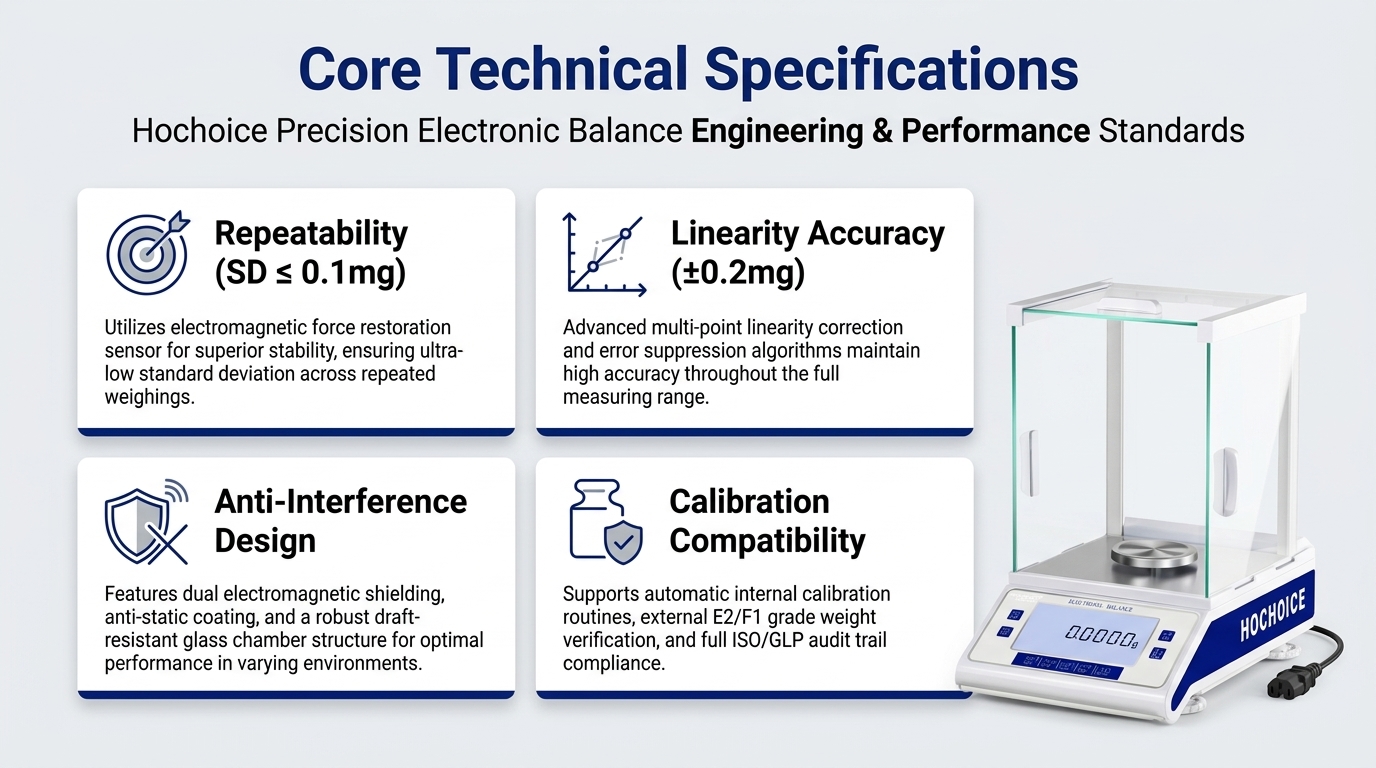
Readability only represents the display resolution of the scale, while true weighing accuracy depends on three core technical indicators, which are the key to stable digital balance calibration:
It refers to the consistency of multiple repeated weighing data under the same environment and weight conditions. Excellent precision balances maintain ultra-low repeatability errors, effectively avoiding data jitter caused by sensor instability. It is the core indicator of daily batch testing and repeated sampling.
Linearity determines the accuracy uniformity of the full weighing range. Many ordinary balances have accurate mid-range data but obvious deviation at low load or full load. High-quality electronic balances maintain consistent linear error throughout the entire capacity range, ensuring reliable data for both trace samples and heavy samples.
Also known as partial load accuracy. It verifies whether the data is consistent when the weight is placed in different positions of the weighing pan. Unqualified eccentric load performance is the main hidden cause of inconsistent test results even after complete calibration of electronic balance.
Laboratory and industrial environments have variable temperature, humidity, vibration and airflow interference. Professional balances need to have excellent environmental adaptability to maintain long-term stability:
High-quality balances adopt temperature compensation sensor design, which can automatically offset micro-deviation caused by ambient temperature changes, avoiding continuous drift of weighing data. Suitable for long-term use in non-constant temperature industrial workshops and conventional laboratories.
Built-in shock absorption structure and optimized wind resistance design can effectively resist bench micro-vibration and slight airflow interference. Analytical balances are equipped with fully enclosed windshields to eliminate convection interference, which is essential for solving unstable readings of high-precision samples.
For powder, plastic and easily static samples, professional anti-static structure and grounded design prevent electrostatic adsorption from causing weighing deviation, greatly reducing abnormal data fluctuations.
Calibration compatibility determines the long-term accuracy retention of the balance, and is a key standard for compliant laboratory equipment:
High-standard electronic balances support both internal automatic calibration and external weight calibration. Automatic calibration can trigger correction according to temperature changes and operating time; external calibration meets audit traceability requirements, perfectly adapting to daily quick correction and regular formal balance calibration.
Excellent zero-point locking and anti-drift design ensures that the zero point does not drift frequently after correct how to reset digital scale to zero operation, reducing repeated zeroing and frequent calibration workload.
Formal compliant balances support standardized calibration records, data storage and parameter traceability, meeting ISO, GMP and other industry quality management system requirements, suitable for pharmaceutical, food, chemical and other regulated industries.
Long-term stable operation is inseparable from professional structural design, which avoids equipment performance degradation caused by daily operation:
Built-in sensor overload protection structure, which can buffer accidental slight impact and overload in daily operation, protect the core load cell, and prevent permanent sensor drift that cannot be repaired by calibration.
The core sensor adopts sealed design to isolate dust, sample residue and humid gas erosion, avoid internal mechanical friction and corrosion, and maintain long-term consistent weighing performance.
According to different testing scenarios, it supports unit conversion, automatic peeling, timing weighing, data output and other functions. It is compatible with daily conventional weighing, sample differential weighing, batch testing and other diversified laboratory operations.
Industrial Production QC: Prioritize vibration resistance, dust resistance and linear stability, focus on continuous high-frequency working stability
Conventional Food & Chemical Laboratory: Focus on temperature and humidity adaptability and repeatability, support regular standardized calibration
Pharmaceutical & Analytical Laboratory: Strictly screen linear accuracy, eccentric load performance and calibration traceability, meet compliance audit standards
Powder & Volatile Sample Testing: Prioritize anti-static, wind resistance and sealed structural design
The core of selecting equipment in the electronic weighing scale market is technical performance matching rather than superficial parameter stacking. Reasonable screening of repeatability, linearity, environmental anti-interference and calibration compatibility can fundamentally solve most problems such as inaccurate weighing and unstable calibration, and maintain long-term consistent and reliable QC test data.
Hochoice electronic balances are fully optimized in core precision performance, environmental adaptability and calibration compatibility, with strict factory performance testing, adapting to various laboratory and industrial QC scenarios, and supporting long-term stable and compliant weighing work.
Related Guide:Balance Calibration Done But Still Inaccurate? 6 Hidden Causes
Related Product:Hochoice Full Series Precision & Analytical Balances
Get Support:Professional scene matching and technical parameter consultation








