

Nearly all modern precision balances offer some form of internal calibration, and many operators rely on it exclusively for routine balance calibration. But internal calibration is not equivalent to external calibration, and for regulated environments, relying only on internal calibration can lead to compliance gaps.
Understanding the differences, strengths and limitations of each method helps you build a calibration program that balances convenience, accuracy and regulatory compliance.
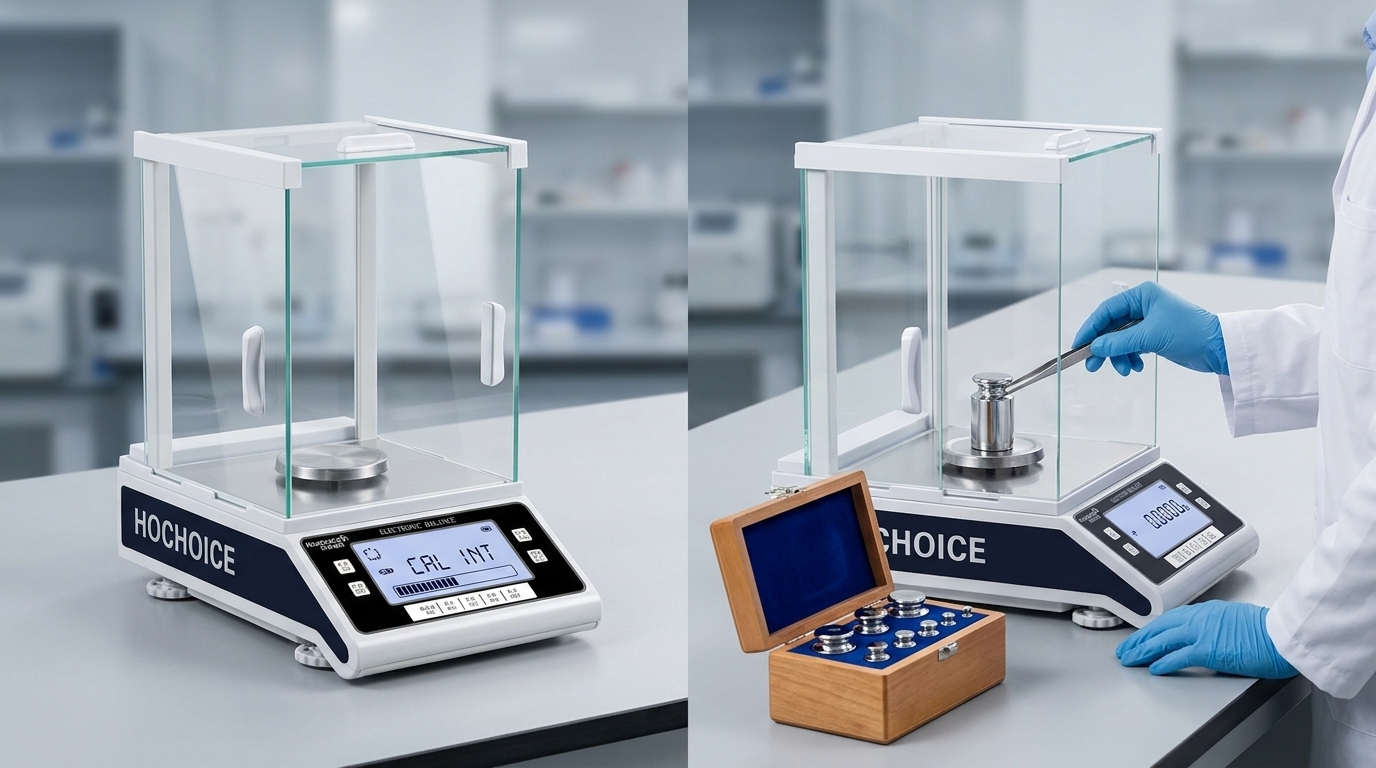
Internal calibration uses a built-in motorized reference weight inside the balance. The system automatically places the weight on the sensor, measures it, and adjusts the calibration factor.Advantages:
Fast and convenient — takes seconds, no manual handling
Consistent and repeatable — no operator technique variation
Can be triggered automatically by time, temperature change or power-on
Sealed from dust, contamination and handling damageLimitations:
Usually single-point calibration only — no full-range linearity verification
Internal weight is not independently certified or traceable
Cannot detect eccentric load errors or mechanical issues
Not accepted as standalone calibration for most regulatory audits
External calibration uses separate, certified physical weights placed manually on the weighing pan. The operator verifies readings across the range and adjusts calibration as needed.Advantages:
Full multi-point linearity verification across the weighing range
Can include eccentric load testing and repeatability assessment
Traceable to national metrology standards via certified weights
Accepted by FDA, ISO, GMP and most regulatory frameworks
Identifies mechanical issues, wear and environmental problemsLimitations:
Slower — takes 5–15 minutes for full procedure
Requires operator training and proper technique
Certified weights require periodic recertification
More susceptible to handling errors and contamination
| Factor | Internal Calibration | External Calibration |
|---|---|---|
| Speed | Seconds | 5–15 minutes |
| Operator skill required | Minimal | Moderate to high |
| Multi-point verification | No | Yes |
| Traceable to national standards | No | Yes |
| Acceptable for GMP/ISO audits | No (standalone) | Yes |
| Detects mechanical issues | No | Yes |
| Best for | Daily routine checks | Formal calibration & compliance |
For most laboratories, the optimal approach is a hybrid program:
Daily/weekly: internal calibration for quick routine checks and drift correction
Quarterly/semi-annual: full external calibration of electronic balance with certified traceable weights for compliance and full performance verification
Between calibrations: periodic single-point external weight checks to verify internal calibration remains valid
This combines the convenience of internal calibration with the accuracy and traceability of external calibration. It is the standard approach recommended by EURAMET cg-18 and ASTM E898 guidelines for analytical weighing.
For regulated pharmaceutical, medical device and food safety industries, internal calibration alone is not sufficient for audit purposes. Formal periodic external electronic balance weight calibration with traceable certified weights is required to maintain GMP compliance and defensible measurement data.
Related Guide:Balance Calibration Weights: How to Choose the Right Accuracy Class
Related Product:Hochoice Balances with Dual Internal/External Calibration Support
Get Service:Traceable external calibration service with accredited certificates
Matching the right calibration method to your application ensures both operational efficiency and regulatory compliance. A hybrid program delivers the best of both worlds.








