

Is your digital scale not reading weight accurately for powders, liquids or plastic samples? Learn sample-specific weighing errors, fixes, and how balance calibration and proper zero reset improve result consistency.
When your digital scale not reading weight consistently, the problem often isn’t the balance itself — it’s the sample. Different materials introduce unique measurement errors that can mimic calibration drift, and many operators waste time repeating balance calibration without addressing sample-specific causes.
High-precision balances detect forces invisible to the operator: electrostatic charge, evaporation, moisture absorption and convection currents all register as weight change on the display. Understanding these material-specific errors eliminates the majority of day-to-day weighing inconsistencies.
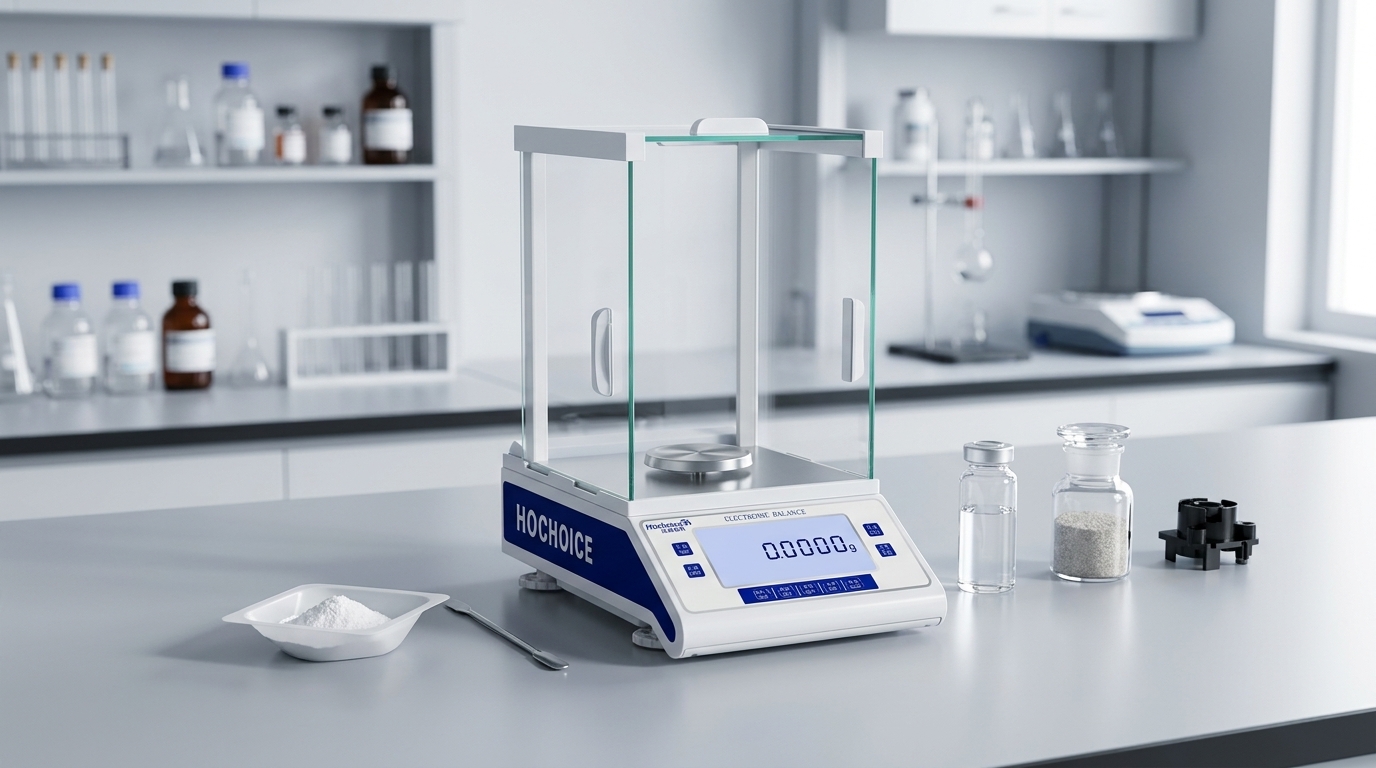
Error pattern: Erratic drifting readings, inconsistent repeatability, results that change between runs.Root causes:
Electrostatic charge: Dry fine powders build up static charge during pouring, stirring or transport. The charge exerts attraction or repulsion against the weighing chamber, pulling readings off by up to several milligrams on analytical balances. Low humidity below 40% makes this effect far worse.
Scattering and residue: Powder spills easily during transfer, leaving invisible residue on the pan that adds ghost weight to subsequent measurements.
Uneven distribution: Dense mounds create uneven load distribution across the pan.
Fixes:
Maintain 40–60% room humidity to dissipate static charge naturally.
Use anti-static weighing boats and grounded spatulas.
Always remove the boat from the balance to add or remove powder.
Follow standard procedure for how to reset digital scale to zero between samples to cancel out residue drift.
Error pattern: Steady downward drift of readings during measurement.Root causes:
Evaporation: Volatile liquids lose mass continuously while exposed to air. The lighter the liquid, the faster the drift.
Surface residue: Liquid on the outside of vials or beakers adds weight and evaporates inconsistently between runs.
Surface tension effects: Contact between the sample container and pipette tips creates force errors.
Fixes:
Use sealed or stoppered weighing vessels for all volatile liquids.
Wipe container exteriors completely clean before weighing.
Work quickly and minimize exposure time.
Never pour liquid directly onto the weighing pan.
Error pattern: Steady, continuous drift in one direction — upward for hygroscopic materials, downward for volatile materials.Root causes:
Hygroscopic samples absorb moisture from ambient air, gaining mass during weighing.
Volatile solids sublimate or evaporate slowly, losing mass over time. This steady drift is very often mistaken for balance calibration failure.
Fixes:
Use tightly sealed weighing bottles with minimal headspace.
Employ the difference weighing method: weigh full sealed bottle, remove a portion, reweigh sealed bottle.
Minimize open exposure time. Work quickly and decisively.
Error pattern: Inconsistent readings that jump between trials, no clear steady value.Root causes:
Static charge buildup: Plastic parts and containers build strong static charge when handled or wiped with dry cloths. The electrostatic force pulls or pushes against the balance pan, creating offset errors that don’t repeat reliablyMETTLER TO....
Temperature mismatch: Molded parts fresh from production are often warmer than ambient, creating convection currents.
Fixes:
Allow plastic parts to fully acclimate to room temperature before weighing.
Avoid wiping plastic surfaces with dry cloth immediately before measurement.
Use anti-static ionizers for chronic static issues.
Ground the balance properly.
If calibration of electronic balance passes with certified metal weights but fails with your actual samples, the problem is almost always sample handling, not the balance. Calibration cannot compensate for poor sample preparation technique.
Related Guide:Balance Calibration Troubleshooting: Complete Step-by-Step Guide
Related Product:Hochoice Analytical Balances with Anti-Static Draft Shield Design
Get Support:Operator training and standard weighing procedure development
Identifying sample-specific errors eliminates most routine weighing issues and reduces unnecessary calibration dramatically.








