

Every balance reaches the end of its service life eventually. But many operators replace equipment too early — or keep using failing balances long after they should be replaced, wasting hours on repeated balance calibration that never holds.
Knowing the difference between normal calibration drift and end-of-life performance degradation saves both money and downtime. A well-maintained precision balance can last 8–10 years in regular lab use; industrial bench scales often last 10–15 years with proper care.
These issues are resolved with standard calibration of electronic balance:
Gradual zero drift from normal sensor settling
Minor linearity shift from normal wear-in
Offset after relocation, cleaning or environmental changes
Temporary drift after seasonal temperature changes
If calibration holds for weeks or months between adjustments, the balance is functioning normally.
Calibration won’t hold at allYou calibrate correctly, and it drifts back within hours or days. This indicates permanent sensor degradation or mechanical fatigue that calibration cannot reverse. If you’re calibrating weekly or more and it still drifts, the sensor is likely worn out.
Poor repeatability that calibration can’t fixSame sample, same conditions, but readings vary significantly between trials. Repeatability degradation is the earliest and most reliable sign of sensor wear. Single-point calibration will pass, but repeated measurements will not agree.
Increasing sensitivity to environmentA balance that used to be rock-solid now reacts to every draft, vibration and temperature change. This means internal damping and compensation systems have degraded over time.
Slow stabilization timeReadings take longer and longer to settle. This sluggishness indicates the load cell or electromagnetic sensor has lost its elastic response and mechanical memory.
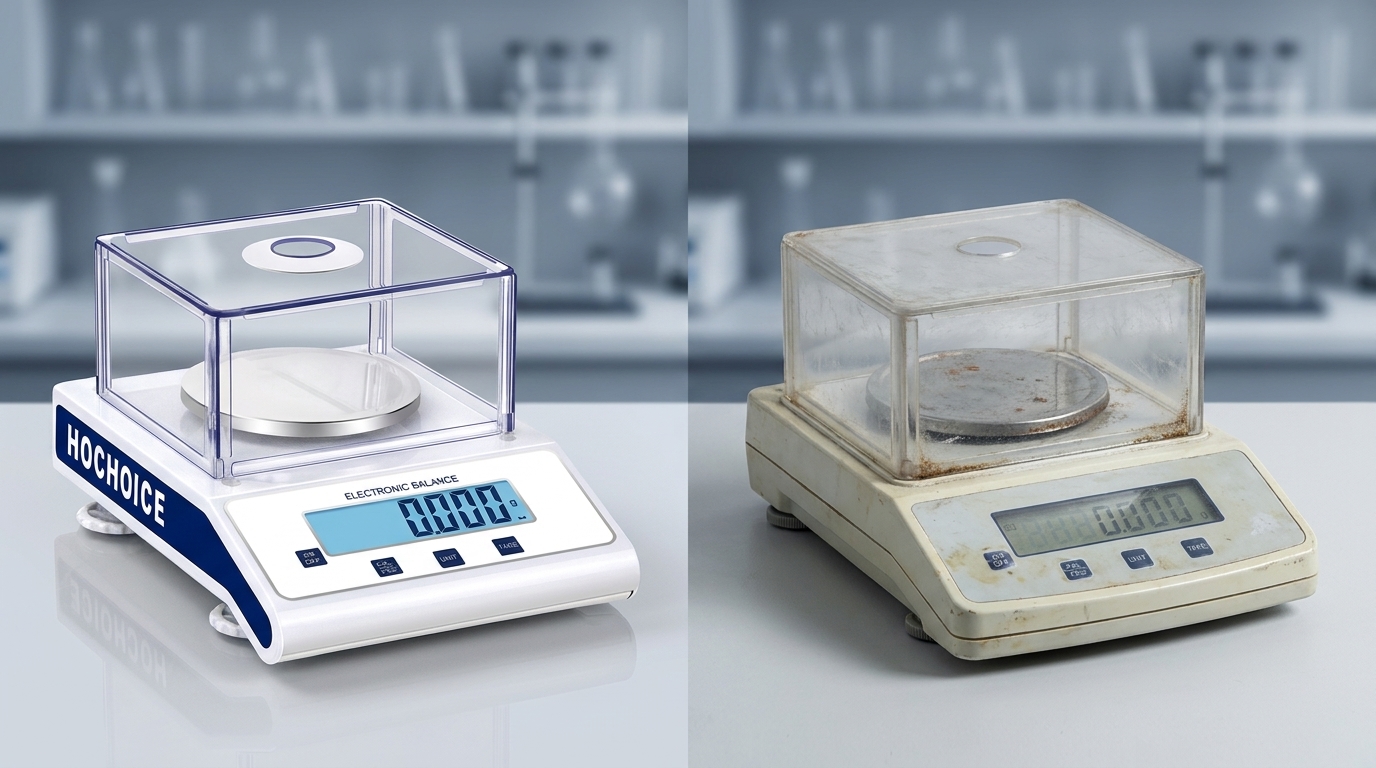
Visible physical degradationCorroded components, bent pan supports, cracked draft shields or loose internal parts. Structural wear leads to consistent mechanical errors that calibration cannot correct.
Frequent repeating failuresSame issue keeps coming back shortly after repair or adjustment. If you’ve fixed the same problem twice in a year, it signals progressive systemic wear.
Obsolete technology and partsSpare parts are discontinued or only available second-hand. The balance lacks basic digital connectivity for modern workflows. One mechanical failure could cause permanent downtime.
You can extend service life by 30–40% with consistent routine care:
Daily: clean pan and chamber, verify zero stability
Weekly: deep clean, single-point verification check
Monthly: multi-point linearity test, mechanical inspection
Quarterly: full electronic balance weight calibration with certified weights
Related Guide:Complete Precision Balance Preventive Maintenance Routine
Related Product:Hochoice Precision Balances with Long-Life Sensor Design
Get Support:Balance performance assessment and end-of-life consultation
Knowing when to calibrate and when to replace eliminates wasted time on failing equipment and prevents bad data from reaching production records.








