

Moisture content can affect the quality, stability and processing performance of many materials.
In food production, pharmaceuticals, chemicals, agriculture and industrial manufacturing, moisture testing is often part of routine quality control.
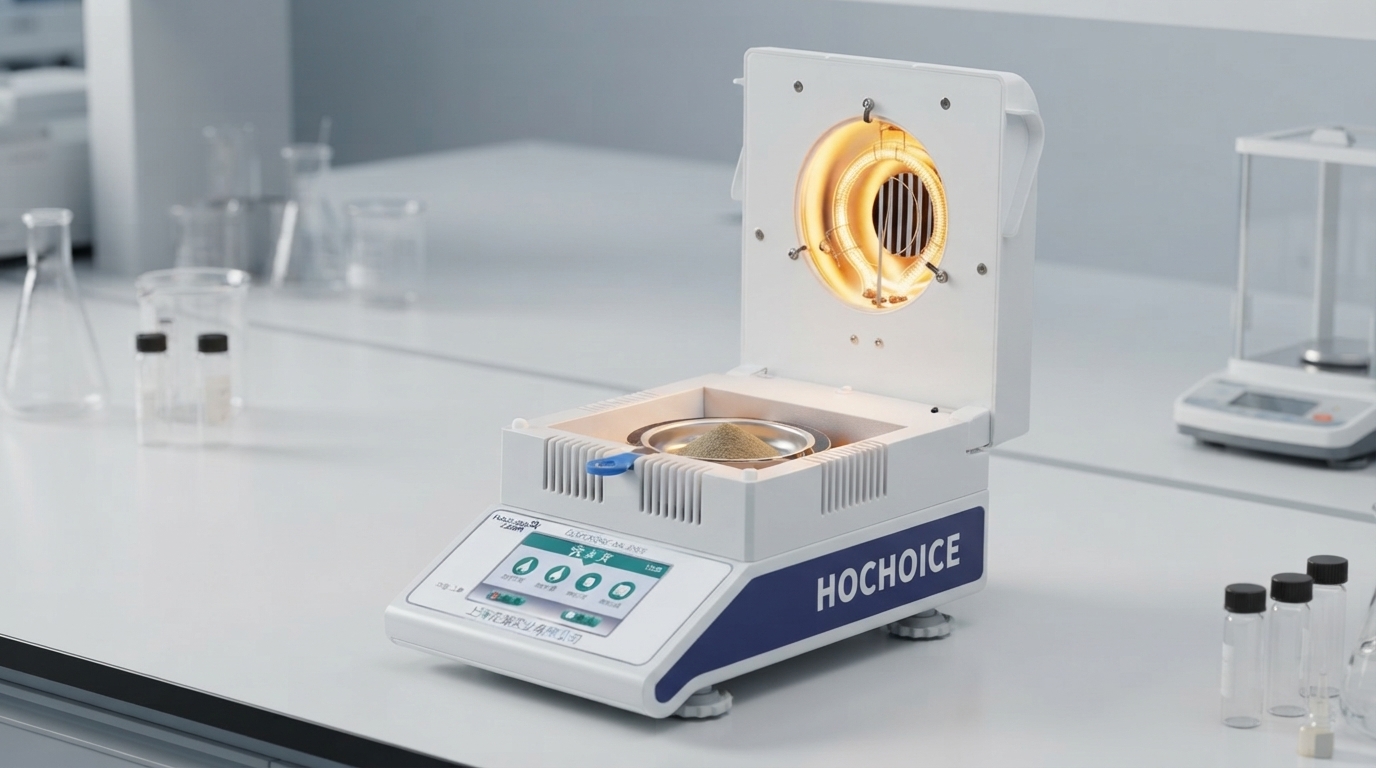
A halogen moisture analyzer combines a weighing system with controlled heating to determine moisture content from the change in sample mass.
For laboratories performing frequent tests, it can provide a convenient alternative to workflows that require separate weighing and drying equipment.
However, the right instrument depends on the sample, testing method and required measurement performance.
A typical halogen moisture analyzer follows a thermogravimetric measurement principle.
The instrument weighs a sample, heats it according to a defined program and continuously monitors the change in mass.
Moisture content is calculated from the initial and final sample masses.
The result depends on the assumption that the observed mass loss represents moisture loss under the selected testing conditions.
This assumption may not hold for every material. Other volatile substances or thermal decomposition can also cause mass loss.
For that reason, sample suitability and method development are important.
The maximum sample capacity determines how much material can be placed on the weighing pan.
HOCHOICE's listed halogen moisture analyzer configurations include 50g and 100g capacities, depending on the model.
However, maximum capacity is not necessarily the ideal sample size for every test.
The actual sample quantity should be selected according to the material, its homogeneity, the testing method and the instrument's instructions.
A representative sample is essential for obtaining meaningful results.
Readability describes the smallest increment displayed by the weighing system.
Moisture readability describes the increment used to display the moisture result.
These specifications should not be confused with measurement accuracy.
For example, a balance displaying more decimal places does not automatically provide a more accurate moisture result.
Buyers should review the manufacturer's specifications for:
Weighing readability
Moisture readability
Repeatability
Measurement accuracy
Maximum capacity
HOCHOICE's published configurations include weighing readability options of 0.001g, 0.002g and 0.005g, depending on the model.
Always compare the specifications for the exact configuration being considered.
Different materials respond differently to heating.
A halogen moisture analyzer with an adjustable heating range can provide flexibility when developing suitable testing methods.
HOCHOICE lists configurations with a heating range of 60–160°C.
However, a higher temperature is not automatically better.
Excessive heating can cause sample decomposition, while insufficient heating may leave residual moisture.
The appropriate temperature depends on the material and the validated or established testing procedure.
Repeatability describes how closely repeated measurements agree under specified conditions.
Accuracy relates to how close the measurement result is to the reference or accepted value.
Moisture testing can be affected by:
Sample preparation
Sample homogeneity
Sample quantity
Heating temperature
Heating duration
Ambient conditions
Endpoint settings
The presence of other volatile substances
For this reason, laboratories should evaluate the complete method rather than relying on one specification.
When comparing suppliers, request the relevant technical documentation and clarify the conditions under which performance specifications were determined.
Different moisture analyzers may offer manual, timed or automatic test modes.
These features can help laboratories adapt the instrument to different materials and workflows.
A timed test ends after the programmed period.
An automatic endpoint function uses the instrument's configured criteria to determine when the test should stop.
Automatic stopping can improve workflow convenience, but the endpoint settings still need to be suitable for the sample.
A consistent test procedure is essential when comparing results over time.
For laboratories that need to record or transfer results, data connectivity may be an important purchasing factor.
HOCHOICE lists RS232 connectivity on its halogen moisture analyzer configurations, with an optional printer.
Before purchasing, confirm that the interface and accessories are compatible with your intended workflow.
Consider whether results will be recorded manually, printed, transferred to a computer or incorporated into an existing laboratory system.
Potential applications for halogen moisture analyzers include:
Food and agricultural materials
Chemical powders
Pharmaceutical raw materials
Minerals and soil
Wood and related materials
Plastics and industrial materials
Manufacturing quality control
Not every instrument or test method is suitable for every sample.
For regulated or standardized testing, confirm that the instrument and method meet the applicable requirements.
Before selecting a moisture analyzer, ask the supplier:
What capacities and readability options are available?
What is the specified moisture repeatability?
What heating temperature range is supported?
Which test modes are available?
Is the required data interface included?
Are sample-specific testing recommendations available?
What documentation, accessories and after-sales support are provided?
Can the supplier support OEM or ODM requirements if needed?
These questions help buyers compare equipment on technical suitability rather than price alone.
Choosing a halogen moisture analyzer requires a clear understanding of sample characteristics, capacity, readability, repeatability, heating conditions and data requirements.
A suitable instrument should match the laboratory's testing method and quality-control objectives.
HOCHOICE provides halogen moisture analyzers and laboratory weighing instruments for distributors, laboratories and industrial quality-control applications.
For model selection, buyers should confirm the required specifications and sample application with the manufacturer.








