

An analytical balance is commonly used to weigh small quantities of materials in research laboratories, pharmaceutical development, chemical analysis, and quality control. However, selecting a balance based only on its displayed decimal places can lead to unsuitable measurement results.
One important consideration is the minimum sample weight: the smallest sample mass that can be weighed while meeting the uncertainty requirements of a particular application.
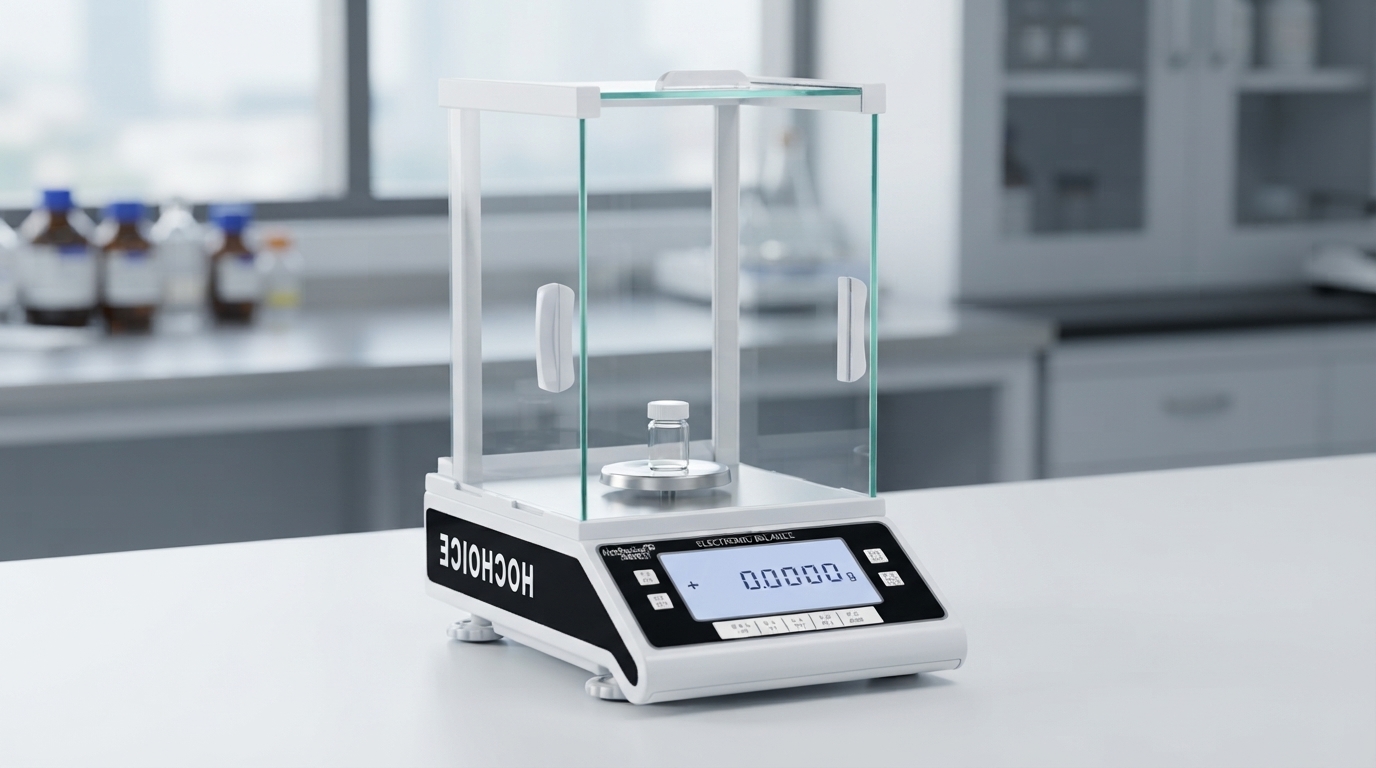
Readability describes the smallest increment displayed by a balance. For example, a balance with 0.0001 g readability displays mass in increments of 0.0001 g.
Minimum sample weight addresses a different question: how much material must be weighed to achieve the required measurement quality?
A balance displaying four decimal places does not automatically guarantee that every sample above 0.0001 g can be weighed with acceptable uncertainty.
The actual minimum depends on factors including repeatability, the balance's performance, environmental conditions, the weighing procedure, and the uncertainty permitted by the application.
Minimum sample weight is particularly important when working with expensive, scarce, or highly concentrated materials.
Examples include:
Pharmaceutical research and formulation development
Chemical analysis and reference sample preparation
Small-quantity laboratory reagents
Fine materials used in research and quality control
If the sample is too small for the required measurement uncertainty, the relative uncertainty can become significant even when the balance displays a stable number.
A practical evaluation begins with the application's allowable relative weighing uncertainty.
In a simplified approach, minimum sample weight can be estimated using the standard deviation of repeated weighing results and the permitted relative uncertainty:
Minimum sample weight ≈ (k × s) / (Uᵣ / 100)
Where:
s is the standard deviation obtained from suitable repeatability measurements.
Uᵣ is the permitted relative uncertainty expressed as a percentage.
k is the coverage factor or other factor specified by the applicable procedure.
For example, if a validated procedure uses a standard deviation of 0.0001 g, a permitted relative uncertainty of 0.10%, and a factor of 2, the estimated minimum sample weight is 0.2 g.
This is an illustrative calculation, not a universal specification. The appropriate method, factor, and uncertainty definition must follow the laboratory's applicable standards and quality procedures.
When comparing analytical balances, review more than readability:
Repeatability: How consistently does the balance measure the same load under specified conditions?
Linearity: How does the indication perform across the weighing range?
Capacity: Can the balance accommodate both the sample and its container?
Environmental suitability: Can the installation control drafts, vibration, temperature changes, and static electricity where relevant?
Verification and calibration: Can the instrument be checked according to the laboratory's documented procedure?
For applications involving very small sample masses, request performance information and an evaluation method appropriate to your required uncertainty.
A 0.001 g balance may be appropriate for many routine laboratory tasks, while applications requiring finer readability may call for a 0.0001 g analytical balance. The correct choice depends on the sample mass and measurement requirements—not simply the number of decimal places.
Before selecting a model, define the intended sample range, acceptable uncertainty, required capacity, and working environment.
Conclusion
Minimum sample weight is an application-specific performance consideration. Understanding the difference between readability and minimum sample weight helps laboratories select equipment that is suitable for their actual measurement needs.
HOCHOICE offers laboratory balances with different capacities and readability levels. Contact our team with your application requirements to identify specifications worth evaluating.








