
Accurate mass measurement is essential in precious metal testing, jewelry manufacturing, refining, and quality inspection. Whether a laboratory is examining gold samples, checking material consistency, or preparing specimens for further analysis, weighing is often one of the first steps in the process.
Because gold is a high-value material, even small weighing deviations can affect material valuation, production records, and analytical calculations.
An appropriate analytical balance helps laboratories measure gold samples with the required resolution and consistency. Reliable results also depend on sample handling, container selection, and a controlled weighing environment.
Gold samples may be weighed for different purposes, including:
Measuring the mass of jewelry components.
Preparing samples for precious metal analysis.
Checking material quantities during manufacturing.
Recording the mass of gold granules or small pieces.
Supporting laboratory calculations and quality inspection.
The required weighing performance depends on the sample size and the purpose of the measurement.
For commercial transactions, legal metrology requirements may also apply. A laboratory analytical balance should not automatically be treated as a legally approved commercial weighing instrument.
The balance should be selected according to the expected sample weight and the required measurement resolution.
Readability
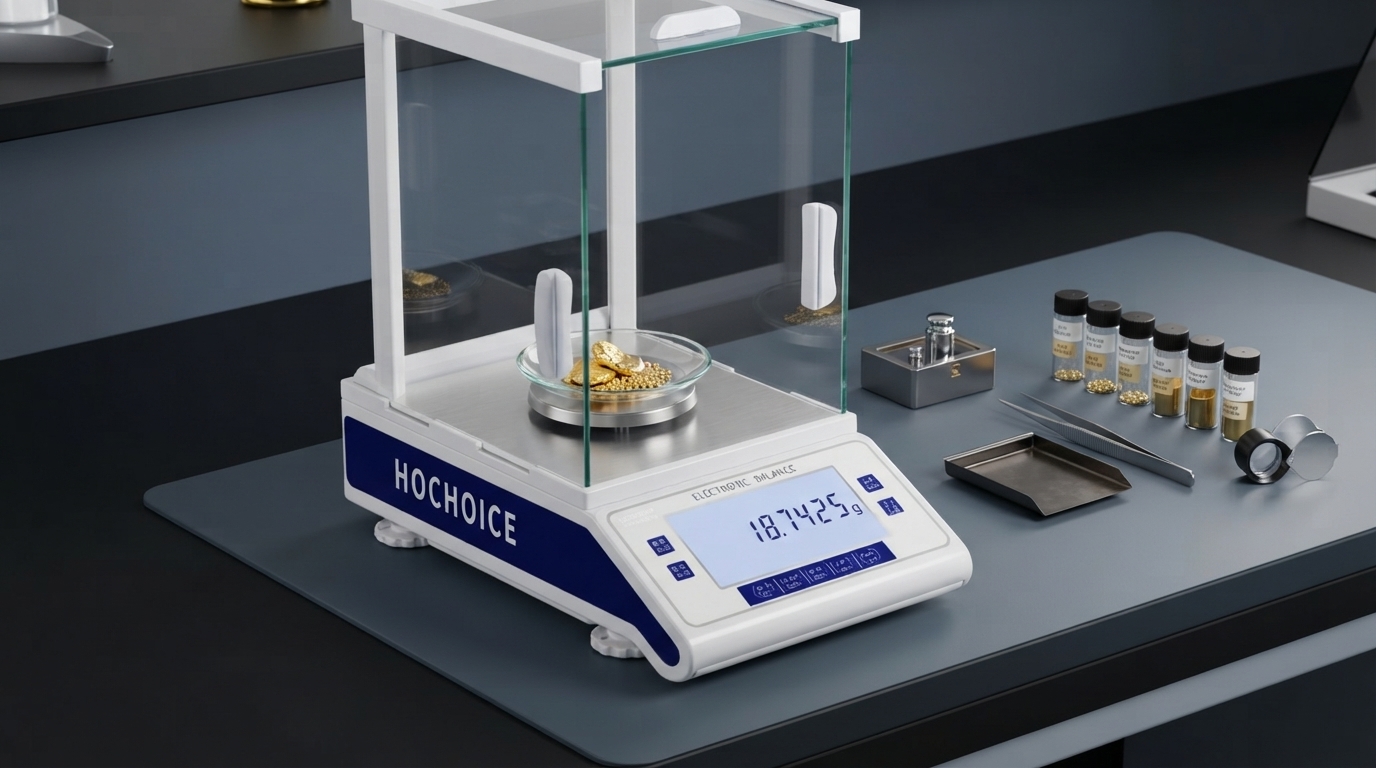
Gold samples can be relatively small, so the displayed increment should be suitable for the intended application. A balance with 0.0001 g readability may be appropriate for certain laboratory measurements that require fine resolution.
Capacity
The maximum capacity must accommodate the gold sample and its weighing container. Users should consider the combined load rather than the sample mass alone.
Repeatability
Consistent readings are important when measuring multiple samples or repeating a measurement during an inspection process.
Weighing pan design
The weighing area should provide enough space for the sample vessel while allowing convenient placement and removal.
Gold samples may be small, irregularly shaped, or difficult to handle with fingers.
Using suitable tweezers or sample-handling tools can reduce direct contact and help prevent accidental loss.
A practical weighing procedure includes:
Prepare a clean and suitable weighing vessel.
Confirm that the balance is ready for measurement.
Place the empty vessel on the weighing pan.
Tare the balance when appropriate.
Transfer the gold sample carefully into the vessel.
Allow the reading to stabilize.
Record the measured mass according to the laboratory procedure.
Remove the sample and clean the weighing area if necessary.
For valuable samples, a designated handling area can help reduce the risk of loss during transfer.
Several factors may influence the weighing of small gold samples.
Air movement
Air currents can affect the stability of sensitive balance readings. A draft shield can help reduce the influence of surrounding airflow when the instrument is designed with one.
Vibration
A stable weighing bench helps reduce unwanted fluctuations. Avoid placing the balance near vibrating equipment.
Contamination
Dust, residue, or material from previous samples may affect measurements. Keep the weighing pan and sample vessels clean.
Static and handling effects
Some weighing containers and surrounding materials can accumulate static charge. Appropriate laboratory handling practices help reduce unwanted measurement disturbances.
A balance displaying four decimal places does not automatically guarantee that every measurement is accurate to that same level.
Readability refers to the smallest displayed increment. Accuracy and measurement uncertainty depend on additional factors, including calibration status, repeatability, linearity, environmental conditions, and the actual load being measured.
Laboratories should select an instrument based on its performance specifications and verify that it is suitable for the intended weighing range.
Gold sample weighing requires suitable balance performance, careful handling, and a controlled working environment. Choosing an analytical balance with appropriate readability and capacity can help precious metal laboratories obtain consistent mass measurements.
For laboratories involved in jewelry testing, refining, or precious metal research, a standardized weighing procedure is just as important as the instrument itself.