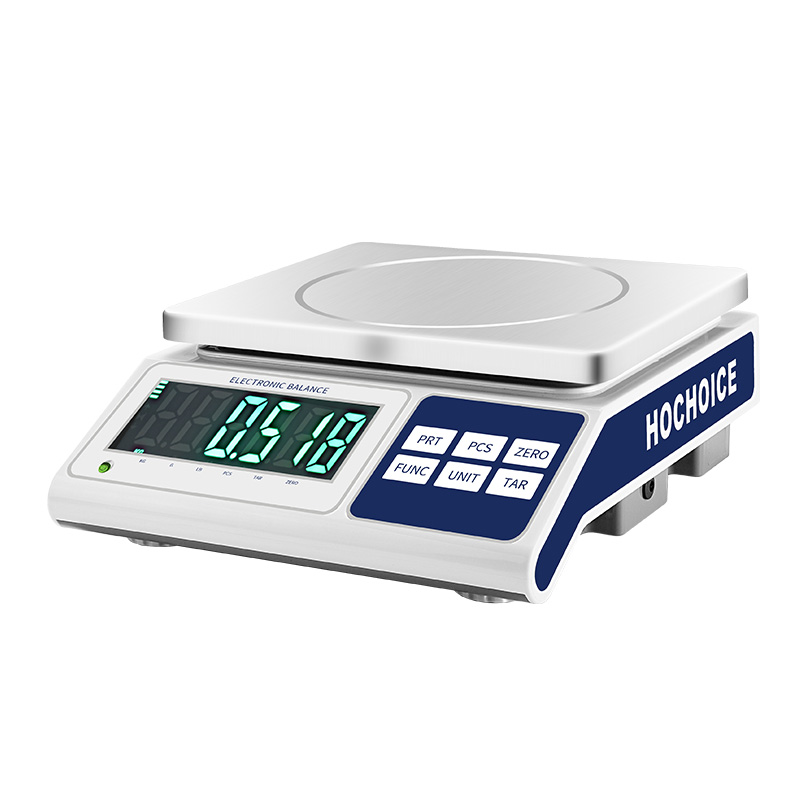


Percentage weighing is a useful function on electronic balances that allows users to compare the mass of a sample with a defined reference mass. Instead of displaying only the measured mass in grams, a balance with percentage weighing mode can display the sample's mass as a percentage of the reference value.
This function can simplify formulation work, material comparison, sample preparation, and laboratory procedures that require relative rather than absolute mass measurements.
Percentage weighing expresses the mass of a sample relative to a reference mass, which is assigned a value of 100%.
The calculation is:
Percentage = (Sample Mass ÷ Reference Mass) × 100%
For example, suppose a reference sample has a mass of 20.00 g. A second sample has a mass of 15.00 g.
Percentage = (15.00 ÷ 20.00) × 100% = 75%
The second sample therefore represents 75% of the reference mass.
The reference mass may be established by weighing a reference sample directly or by entering a reference value, depending on the balance's available functions.
Although the exact operating procedure varies by model, the general process follows three steps.
Place the reference material on the balance or enter its mass if the instrument supports manual reference entry. The balance assigns this value to 100%.
Remove the reference material when required by the operating procedure, then place the comparison sample on the weighing pan.
The balance calculates the sample mass relative to the stored reference value and displays the result as a percentage.
Some models may also support setting a target percentage or using percentage results alongside other weighing functions. Users should confirm the available functions and operating sequence in the relevant manual.
In laboratories that compare ingredients or prepare material mixtures, percentage weighing can help users assess how the mass of an ingredient relates to a reference quantity. It can support routine preparation, provided that the formulation procedure defines the correct reference.
Quality-control teams may use relative mass measurements to compare components or samples against a defined reference. The method is particularly useful when the acceptance criterion is expressed as a percentage rather than a fixed mass.
Researchers may compare the mass of multiple samples with a standard sample. Percentage weighing makes the relative difference easier to read without manually calculating every result.
The function can help students understand relative mass, ratios, and percentage calculations through direct measurement.
However, percentage weighing alone does not establish chemical composition, purity, or concentration. Those properties require an appropriate analytical method.
The accuracy of a percentage result depends on the quality of the reference value and the balance measurements.
If the reference mass is entered incorrectly, every subsequent percentage result may be systematically wrong. If the reference sample is unstable, contaminated, or weighed under different environmental conditions, the comparison may also be unreliable.
For better results:
Use an appropriate and clearly identified reference sample.
Confirm the reference mass before starting a series of measurements.
Keep containers and handling procedures consistent.
Avoid drafts, vibration, and other sources of weighing instability.
Follow the balance's specified operating procedure and readability limitations.
A percentage display does not automatically make a measurement more accurate than the underlying mass measurements.
Ordinary weighing displays the measured mass in units such as grams or milligrams. Percentage weighing instead reports the mass relative to a defined reference.
For example, a balance may display 18.00 g in ordinary weighing mode. If the reference mass is 20.00 g, the same sample corresponds to 90% in percentage mode.
Both results describe the same sample, but they answer different questions. The mass value indicates how much material is present; the percentage indicates how that mass compares with the reference.
Not every electronic balance includes a percentage weighing function. When selecting an instrument for laboratory or production work, users should confirm:
Whether percentage weighing mode is available.
Whether the reference mass can be stored or entered manually.
The maximum weighing capacity and readability.
Whether the displayed resolution is appropriate for the intended application.
Whether results can be transferred to a computer or recorded through an available interface.
The most suitable balance depends on the sample mass, required measurement resolution, workflow, and documentation requirements.
Percentage weighing allows an electronic balance to express a sample's mass relative to a reference mass set at 100%. It is useful for comparing samples, supporting formulation workflows, and performing routine relative-mass checks.
Reliable results depend on a correct reference value, suitable balance specifications, and consistent weighing practices. Before using this function in a controlled procedure, confirm that the balance supports the required mode and follow the manufacturer's instructions.